This is an unofficial fan archive of J-WAVE "TOKIO HOT 100". Not affiliated with, endorsed by, or connected to the program or the artists.
On December 5, 2025, a train pulled into Shonandai Station on the Sotetsu Izumino Line, and the platform speakers started playing Hoshino Gen’s “Toki yo.” A ten-year-old album cut, now the sound of a commuter’s afternoon. Sagami Railway announced the song as the station’s train approach melody, an idea proposed by a Shonandai staff member and timed to the tenth anniversary of the music video. No label push, no chart re-entry — just a station employee who wanted to hear this specific song every day. That, honestly, tells you almost everything about “Toki yo.” It didn’t sprint up the charts. It was slowly taken in by time itself.
The song isn’t fast. It isn’t flashy. It took ten years for a lot of us to hear what it was actually doing.
Key facts
- “Toki yo” is a track from Hoshino Gen’s fourth album YELLOW DANCER, released December 2, 2015. It was never issued as a single.
- The music video was shot at Shonandai Station on the Sotetsu Izumino Line, and has passed 50 million YouTube views as of late October 2025.
- In 2016 it was used in a U-CAN correspondence course commercial, with Hoshino himself appearing on screen.
- On December 5, 2025, it became the train approach melody at Shonandai Station, tied to the MV’s 10th anniversary.
- YELLOW DANCER is Hoshino’s concept album around “Yellow Music” — Black music reinterpreted through a Japanese pop sensibility.
The last breath before “Koi”
Short version: back in 2015 most of us filed “Toki yo” under “nice deep cut.” Ten years and one national-phenomenon single later, it hits differently. This is the last breath of Hoshino Gen before he becomes the pop star we know — the version right before “Koi” and the choreography that ate the country.
In December 2015 he was still being introduced as “the singer-songwriter making his first Kohaku appearance,” with YELLOW DANCER as the album carrying that moment. Ten months later, “Koi” landed. Everything after that is a different story.
So “Toki yo” sits on the edge of that shift. He hasn’t reached yet. Still mid-run-up. That unfinished quality is exactly what keeps the song from aging. He isn’t selling you anything. He’s just calling out to time.
And unlike “SUN” or “Week End” on the same album — tracks built for the floor — “Toki yo” is a sit-down song. Horns, handclaps, the bones of Black music, all present. But it never pushes you to move your body. YELLOW DANCER was Hoshino’s attempt to reinterpret Black music as a Japanese artist under the banner he called “Yellow Music,” and “Toki yo” is the softest, most Japanese-feeling end of that spectrum.
Where it sits inside YELLOW DANCER
Hoshino described the album as five years of quietly chasing the fusion of his own writing with the Black music he loved — soul, jazz, R&B, jump blues — going all the way back to “Yuge,” a B-side on his 2011 debut single. Not a pivot. A crystallization.
The production choices back that up. He brought in engineer Shojiro Watanabe and, unusually for a singer-songwriter, put down the guitar for most of the record to focus on vocals and overall direction. Bigger call than it sounds. Once you stop playing on the track, you have to hear the whole room instead of your own hands. You can feel that in “Toki yo” — reverbed keys up front, drums pulled slightly back, horns easing in like they’re breathing.
Within the album, this track occupies a strange spot. Not a lead single, not one of the experimental cuts. The quiet room off the main hallway of the party. Easy to miss on first listen. Harder to leave alone later.
What I keep coming back to is the low end. The bassline doesn’t move much. In a soul or funk vocabulary that’s the spot where a bass would normally get sticky and start walking. “Toki yo” refuses. The motion lives up top — handclaps, hi-hat, the ticking layer — while the bass stays as the ground. That division of labor is why the song feels like a road you can walk on, not a floor rocking under you. It’s why a station-platform loop was even conceivable.
The vocal is placed a step back too. Hoshino isn’t reaching. He’s talking to you at conversational distance. Compare “Idea” or “Fushigi” from later in his catalog — those are performed. “Toki yo” isn’t quite performed yet. The voice lives inside the arrangement, not on top of it.
How the sound actually works
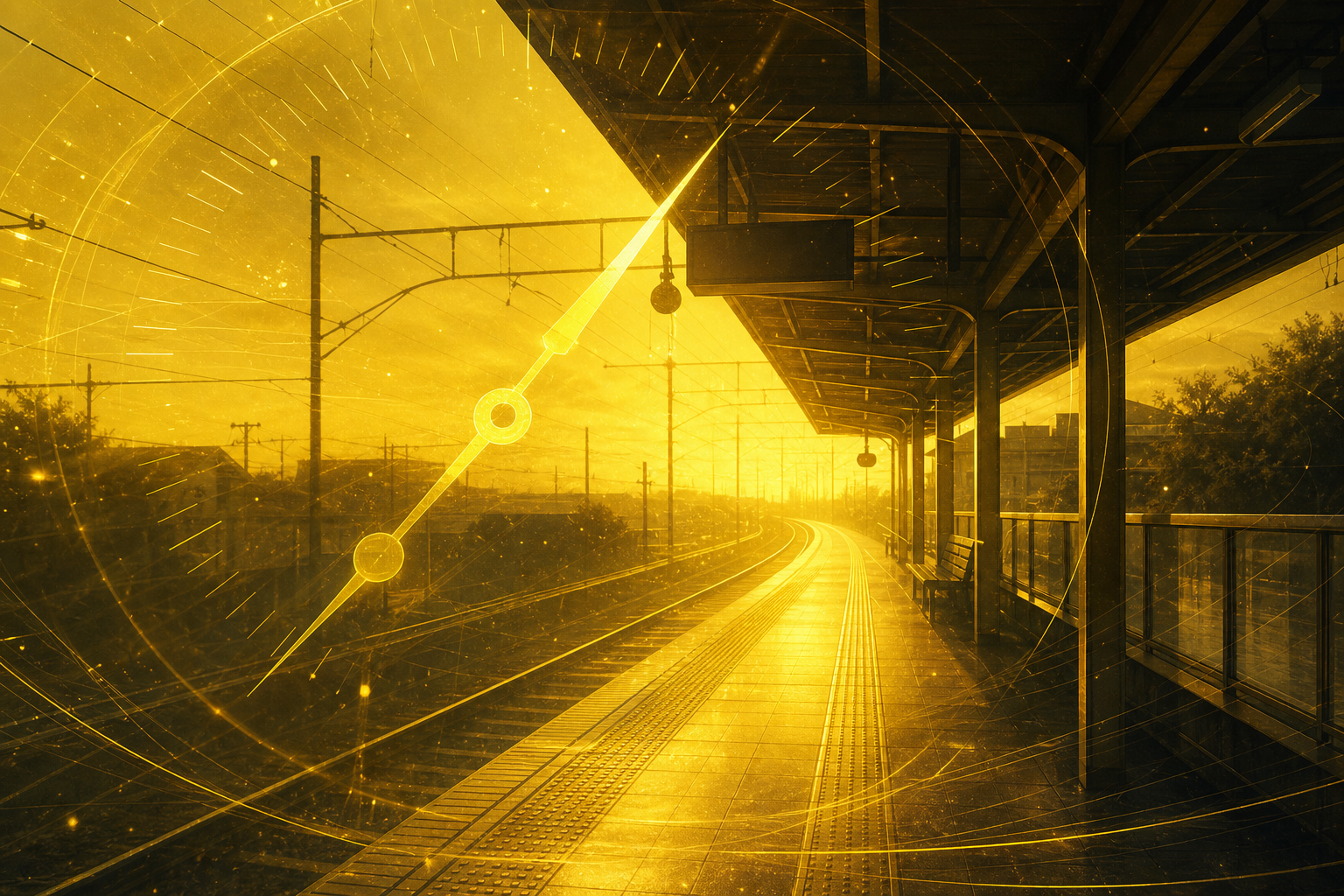
Think of the arrangement as a clock. Mid-tempo, a slightly shuffled 16-beat, and that hard, clap-adjacent percussion locked to the grid — that’s the second hand. It doesn’t hurry you. It just keeps moving.
The horns are the interesting part. Arrangement credit goes to Mio Okamura, Satoshi Takeshima and Hoshino himself, and you can feel real horn players in the writing. Brass doesn’t roar over the climax. It answers back in the gaps between vocal lines, quick and short. Soul and R&B grammar — the Fillmore-era call-and-response — dropped almost casually into a J-pop vocal song.
The other small invention is the choir stack in the back half of the chorus. The female voices don’t go for gospel-style outward shouting. They swell like light coming through a window. Not celebratory. More like morning arriving. That’s why “Toki yo” is oddly hard to program at a graduation ceremony but hits so hard when you actually graduate.
Three things to listen for
- The clock-hand percussion. On earbuds, that hard clap sits dead center and never lets up.
- Horns as reply, not roar. They fill the pockets between vocal phrases — R&B phrasing, quietly translated into pop.
- The chorus swell. Track how the backing vocals thicken in the second half of the hook. The temperature of the song shifts right there.
Where the song actually lives
A lot of listeners will recognize this feeling: you want to use “Toki yo” at a graduation, but it doesn’t quite fit. Thematically it’s a milestone song. But it’s too internal for a gymnasium PA, and not quite an introspective ballad either. That in-between temperature is why it lands harder at personal milestones — a new job, a last day, the morning before you go see someone you’ve been putting off. Less ceremony, more soundtrack to a private turning point. The kind of song that ends up on a “leaving Tokyo” playlist or a “final day at the old apartment” playlist. Quietly. Not as a headliner.
And now it’s a station jingle. Which is huge, actually. A train approach melody is a fifteen-second fragment that people in that neighborhood hear multiple times a day, every day. That slot doesn’t go to anthems. It goes to music that can survive daily life. So “Toki yo” being picked for it means the song did something rare over ten years — it grew from an event song into an everyday song. Not many pop songs make that trip.
Personal read: this song opens up in a car. On a long, flat stretch of highway, the steady clap starts lining up with the rhythm of the road, and your sense of time stretches out slightly. Evening commute more than morning. Your mileage may vary. But I’d argue it’s a song that shows its full self in motion.
There’s also a timing thing worth noting. December 2015 was an odd moment in Japanese pop. Apple Music had just launched in Japan a few months earlier, and streaming culture hadn’t fully arrived. Songs from that period were still being written for album-length listening. Then Spotify entered Japan in September 2016, playlist logic took over, and album cuts started getting discovered on their own terms. “Toki yo” quietly rising past 50 million YouTube views a decade later isn’t a single’s number. It’s the number of a song picked up one playlist at a time, by people making soundtracks for their own lives.
One more layer you can’t unhear now. Hoshino’s two subarachnoid hemorrhages in 2012 and 2013 are widely known. YELLOW DANCER was his first album after coming back. “Toki yo” — literally “O, Time” — sits inside that record. In 2015, most of us read the title at surface level. His later interviews and writing (including Inochi no Shasou Kara) made the weight of that theme much clearer. Ten years on, hearing a survivor’s voice tucked inside a celebratory-sounding pop record changes the whole song.
Looking back at it from “Koi”
Ten months after “Toki yo” hit shelves, “Koi” came out as the theme to Nigeru wa Haji da ga Yaku ni Tatsu, the choreography went national, and Hoshino became a household name. He himself has framed “Koi” as directly downstream of YELLOW DANCER — the key song for what came after that album.
Which means the 2015 album and “Koi” are one continuous line. “Toki yo” is the point on that line where he leans furthest into pure songwriting — no dance-track showmanship like “SUN,” no experimental left turns. Just melody and vocal weight. Critics have noted that Hoshino anchors himself in Black music rhythm but deliberately avoids riff-based repetition in favor of songs you can sing along to. “Toki yo” is that design philosophy in an early, clean form, and you can hear it carried straight into “Koi.”
Going back to it now feels like hearing Hoshino Gen just before he became the version who could write “Koi.” He hasn’t landed yet. Hit songs sometimes inhale so much of their era that they get heavy later. “Toki yo” doesn’t carry that weight — partly because it wasn’t the hit.
The MV, Shonandai, and how a song stays in a place
The “Toki yo” music video was shot at Shonandai — gates, platform, stairs, departure boards. Nothing scenic. A totally normal suburban station. It was filmed on the platforms and ticket gates of that station, and the playful concept caught on. For anyone who watched the MV at the time, Shonandai basically became “the Toki yo station.”
A decade later, the relationship flipped. The station started playing the song back into the neighborhood. And the detail that matters most: it wasn’t a corporate tie-in. A station staff member proposed it, tied to the MV’s 10th anniversary. Somebody who worked there listened to this song enough times, over enough years, to want it as the sound of their platform. As far as long lives for a pop song go, that’s about as good as it gets.
The 2016 U-CAN commercial — the “Opening” spot with Hoshino himself on camera — already proved the song could work in a commercial context. But TV commercials run for a few months. A station jingle plays every time a train comes in, for as long as they choose to keep it. The gap between those two lifespans is almost too on-the-nose for a song called “Toki yo.”
The numbers, and where to start
“Toki yo” was never released as a single. It still passed 50 million YouTube views by late October 2025. For a ten-year-old album cut with no single push, that’s a strong number.
Meanwhile, 2025 Hoshino is on a different scale — a national tour, a successful Korean arena show, and a live release, Gen Hoshino presents MAD HOPE Japan Tour, capturing the second night at Osaka-jo Hall, out April 22. That’s the artist handing a ten-year-old album track back to a neighborhood as its everyday sound. You can measure a career by hits, or by how many old songs quietly keep gaining ground. The second measurement is the one that describes Hoshino now.
Where to go next
If “Toki yo” is your entry point, the natural next song is “SUN” from the same album — the loud, dance-forward face of Yellow Music, the yang to “Toki yo”‘s yin. Next album, YELLOW DANCER front to back, because “Toki yo”‘s placement on it starts to make sense in context. Then “Koi,” so you can feel what Hoshino meant when he called it the key song for what came after that album.
A song that grew into its title
People say the title outran the song. A track called “O, Time” got answered back by time itself, ten years later, in the shape of a station jingle. You can’t design that. It’s more like the song’s personality got proven out over a decade.
Here’s the part I’d genuinely like to hear other fans on. Is “Toki yo” a prayer or a pep talk? Is the singer calling out to time, or is time calling out to the singer? I’ve mostly heard it as the first one. Since it became the Shonandai melody, I’ve started hearing it more as the second — like time itself giving the commuter permission to go. That split is probably a good sign.
Picture the Shonandai platform one more time. Someone coming home from work, a student off practice, someone carrying too much. Fifteen seconds of song, a train pulls in, the day keeps going. That’s the room this song grew into over ten years. That, right now, is how “Toki yo” reads.

コメント